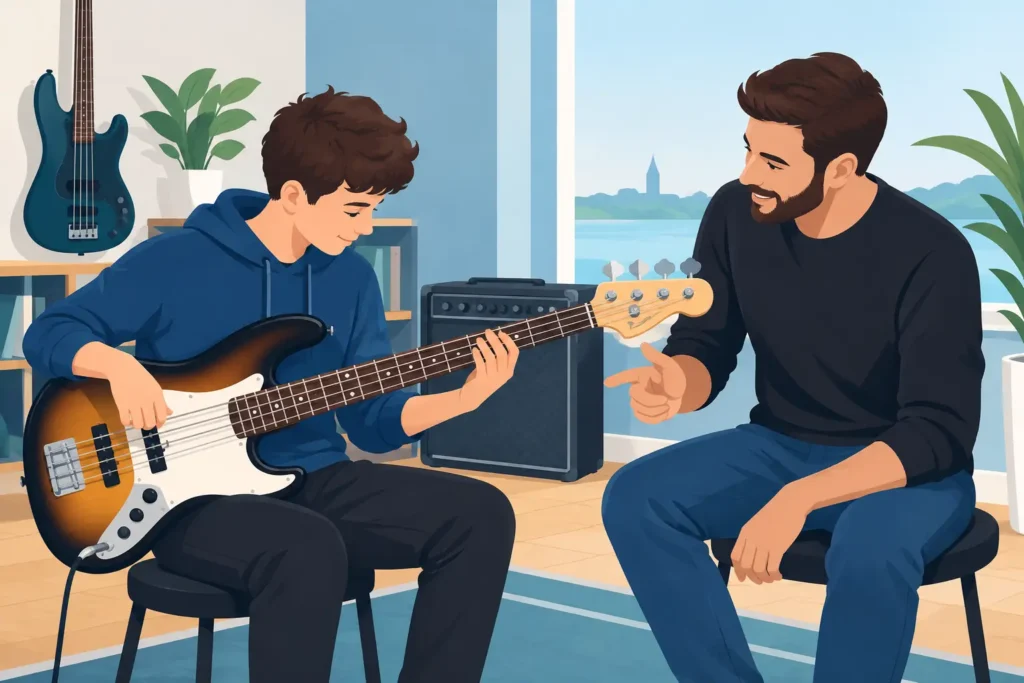
The bass is often the instrument that makes a song feel as though it has properly arrived. It gives the drums shape, supports the harmony and creates the pulse that keeps everyone moving together. Beginner bass guitar lessons Essex can help you or your child become part of that foundation from the very first notes, with patient teaching that makes the instrument feel approachable rather than mysterious.
You do not need previous musical experience, large hands or a background in guitar to begin. You need an instrument that is comfortable to hold, a teacher who explains things clearly and regular time to play. With the right start, bass can become a rewarding hobby, a route into playing with other musicians or the beginning of a lifelong love of music.
Why choose bass as your first instrument?
The bass guitar has a distinctive job in almost every band. Rather than playing lots of high notes at once, bass players create low, steady lines that connect the rhythm of the drums with the chords played by guitars, keyboards or vocals. It is a role that teaches listening as much as technique.
That makes bass an excellent choice for children, teenagers and adults who enjoy the sound and energy of music but are not necessarily drawn to the spotlight. A confident bass player may not always be the loudest person in the room, yet the whole group notices when the bass part is missing. Learning to hold a groove brings a real sense of purpose early on.
There are practical advantages too. Beginners can start with simple patterns on one or two strings and quickly play along with familiar songs. Progress then builds naturally: cleaner notes, better timing, more varied rhythms, movement around the fretboard and greater confidence performing with others.
It is worth being realistic, though. Bass may look simpler than guitar because it commonly has four strings, but it asks for consistency. Playing the right note is only part of the task. Playing it at the right time, with an even sound and the right length, is what makes a bass line work. Good tuition turns that challenge into an enjoyable habit rather than a source of frustration.
What beginner bass guitar lessons in Essex should cover
A strong first lesson should make space for questions and give the learner something achievable to take home. Before tackling complicated songs, a specialist teacher will usually help with the basics of posture, how to hold the instrument, and how to position both hands without unnecessary tension.
From there, lessons can introduce string names, frets and simple note patterns. Beginners learn how to make notes sound clear, how to stop strings from ringing when they should be silent and how to keep a steady pulse. These small details matter. They prevent poor habits from becoming difficult to change later.
Rhythm is at the heart of bass playing, so counting and listening are woven into the learning from the start. This may mean clapping a rhythm before playing it, working with a metronome or playing alongside a simple backing track. Some learners enjoy notation and music theory straight away; others gain confidence first by learning through chord charts, diagrams and familiar tunes. The best approach depends on the learner, and lessons should adapt as their understanding grows.
Learning songs without skipping the foundations
Playing music you recognise is motivating, particularly for younger learners and adults fitting a new hobby around busy weeks. A well-chosen song can teach repetition, timing and musical structure without feeling like an exercise.
However, a teacher should also explain what sits behind the song. Knowing why certain notes fit a chord, or how a repeated rhythm supports a verse and chorus, gives a player choices. It means they are not only copying a line but beginning to understand the language of music.
Over time, learners can explore fingerstyle playing, using a plectrum, simple scales, changing position smoothly and creating their own bass parts. There is no need to rush this process. Solid fundamentals give a player more freedom later, whether their interests lead towards rock, pop, funk, indie, jazz or another style.
Choosing the right lesson format
One-to-one bass tuition offers individual attention and a pace tailored to the learner. It is particularly helpful for complete beginners who would like support with technique, for children who benefit from focused encouragement, or for adults returning to music after a long break. Each lesson can respond to what has gone well that week and what needs more time.
Live online lessons can suit families and adults whose schedules make travel difficult. They work best with a reliable internet connection, a quiet corner and a little preparation before the lesson begins. In-person tuition has the advantage of close guidance on posture and hand position, while online learning can bring welcome flexibility. Neither format is automatically better – it depends on what makes regular learning most realistic for you.
At Allegro Music Academy, learners can choose from individual, small-group and live online tuition, with experienced teachers and purpose-built teaching rooms available across its Essex academies. The aim is to make progress feel clear and encouraging, whatever your age or starting point.
Finding a first bass that feels good to play
A comfortable instrument makes a considerable difference to a beginner’s experience. A bass that is too heavy, poorly set up or difficult to tune can make practice feel harder than it needs to be. Children and smaller players may find a short-scale bass easier to manage, while many adults are comfortable with a standard full-scale instrument.
There is no single correct choice. The style of music a learner likes, their hand size, their budget and the feel of the instrument all matter. Trying an instrument with knowledgeable guidance is preferable to selecting one based only on appearance. A basic amplifier, lead, tuner and suitable strap are also useful, but the essentials should not become a barrier to getting started.
An instrument’s setup is especially important. If the strings sit too high above the fretboard, pressing notes can feel unnecessarily demanding. Professional retail and servicing advice can help a new player begin with equipment that is reliable, comfortable and properly adjusted.
Practice that fits real life
A beginner does not need hours of practice every day. Short, focused sessions completed regularly are usually more useful than one long session at the weekend. Ten to fifteen minutes can be enough to revisit a rhythm, improve a tricky change between notes and play through a favourite section of a song.
A simple routine works well: tune the bass, warm up with a familiar exercise, revisit the current lesson task, then finish by playing something enjoyable. Parents can support younger players by helping establish a calm, predictable practice time, but encouragement is more valuable than pressure. Progress is not always obvious from day to day; it becomes clear over several weeks of steady effort.
Adults should give themselves the same patience. It can feel strange to be new at something, especially after years spent being competent in work or family life. Music lessons offer a rare chance to learn for enjoyment, with measurable progress that belongs entirely to you.
When will a beginner be ready to play with others?
There is no fixed milestone. Some learners are ready to play a simple repeated line with a drummer or guitarist after only a few lessons; others prefer more time building confidence alone. The important thing is not perfection but being able to listen, keep going if a small mistake happens and return to the beat.
Playing with others is one of the best reasons to learn bass. It develops awareness, concentration and musical generosity. A beginner who can hold a straightforward groove may contribute more to a group than someone attempting a complicated part without steady timing.
The first bass line may be only a handful of notes, but those notes can change how a song feels. Give yourself time, listen closely and enjoy every small improvement. The joy of music often begins not when everything is perfect, but when you realise you can help make the sound happen.