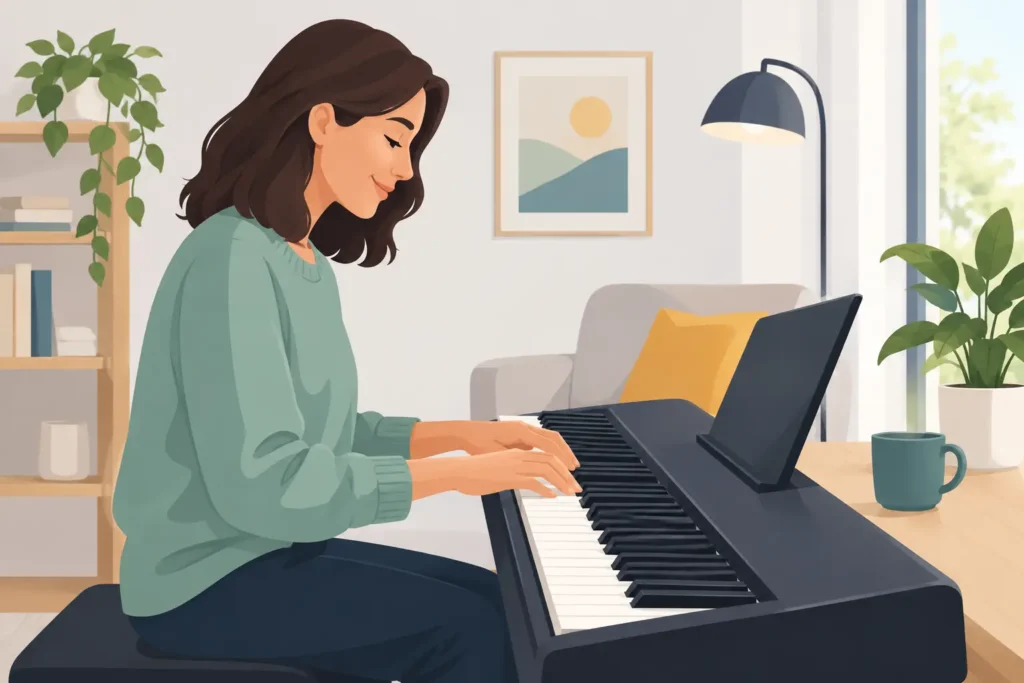
The first few notes on a keyboard can feel surprisingly significant. You may be returning to music after years away, fulfilling a long-held ambition, or simply looking for a creative break from a busy routine. Adult beginner keyboard lessons offer a welcoming way to start, with enough structure to make progress and enough freedom to enjoy the music that made you want to play in the first place.
You do not need previous experience, perfect timing or the confidence to perform in front of anyone. You only need curiosity, a keyboard to practise on, and a teacher who can meet you at your starting point.
Why keyboard is a rewarding instrument for adults
The keyboard is an especially approachable first instrument because the layout makes musical patterns visible. Each note is clearly arranged from low to high, and the black and white keys give you useful visual landmarks from your very first lesson. This can make it easier to understand pitch, chords and scales than on instruments where notes are less immediately visible.
It is also wonderfully versatile. One week you might be learning the opening of a favourite pop song; another, working on a gentle classical piece, a blues rhythm or the chords to accompany singing. Many keyboards include a range of sounds and backing rhythms too, which can make home practice feel more playful and musical.
That said, the keyboard is not effortless. Playing both hands together, reading music and keeping a steady pulse all take patient repetition. The value of well-planned tuition is that these challenges are introduced in manageable stages, rather than arriving all at once.
What adult beginner keyboard lessons should cover
A good first course does more than teach a collection of tunes. It builds the foundations that allow you to learn music independently and enjoy a wider choice of songs as your confidence grows.
Getting comfortable at the instrument
Early lessons usually begin with posture, hand position and finding your way around the keys. You will learn the musical alphabet, identify groups of black keys and use them to locate notes quickly. These small details matter: feeling physically relaxed and knowing where to place your hands helps prevent frustration later.
Your teacher will also introduce basic rhythm. This may involve clapping, counting aloud or playing simple patterns with one hand. It can feel elementary, but a reliable sense of pulse is what turns separate notes into music.
Reading music at a sensible pace
Some adults worry that music notation will be too difficult, particularly if school memories of lessons were not positive. In reality, reading music works best when it is taught alongside playing, not as a test to pass before you are allowed to enjoy a song.
You may begin by recognising a few notes and simple rhythms, then gradually learn how the two staves relate to the right and left hands. Chord symbols and lead sheets can be introduced too, depending on the styles you enjoy. There is no single correct route: a learner who wants to accompany songs may prioritise chords, while someone drawn to piano pieces may spend more time developing notation skills.
Building coordination without rushing
One of the biggest milestones for beginners is using both hands together. At first, this might mean a melody in the right hand with single notes or very simple chords in the left. Gradually, the left hand can take on bass patterns, fuller harmony and rhythmic accompaniment.
The secret is not to force speed. Slow, accurate practice develops coordination far more effectively than repeatedly trying to play a piece at full tempo. A specialist teacher can spot where tension or uncertainty is getting in the way and suggest a smaller step that makes the next attempt feel possible.
Choosing the right lesson format
Adult learners often have work, family and other commitments, so the best format is the one you can attend and practise around consistently. Private one-to-one tuition offers a highly personalised approach. Your teacher can adapt the pace, choose music around your interests and give focused help with the areas you find most challenging.
Small-group lessons can suit adults who enjoy sharing the experience with others at a similar stage. They bring encouragement, listening skills and the reassurance that everyone is working through the same early questions. Live online lessons are another practical option when travel or a changing schedule makes regular attendance difficult.
There are trade-offs. A group setting can be motivating, but it naturally provides less individual playing time. Online learning is convenient, although it relies on a suitable instrument, reliable connection and a quiet place to concentrate. For many people, the right answer depends on personality as much as timetable.
How much practice do you really need?
Consistency matters more than long sessions. A realistic routine of 15 to 20 focused minutes on several days each week will usually take you further than one rushed hour at the weekend. Adults are often excellent at practising thoughtfully because they understand why a particular exercise or passage needs attention.
Try to give each practice session a simple purpose. You might spend a few minutes revisiting a warm-up, then work on a difficult two-bar section before playing something familiar for enjoyment. Finishing with a piece you can already play is not avoiding the hard work – it helps you hear your own progress.
Keep the keyboard easy to access if possible. An instrument packed away in a cupboard is less likely to be played than one that is ready on a stand, with a comfortable seat and good lighting. Headphones can make regular practice realistic in a busy household, provided you still take time to listen carefully to tone and balance.
Choosing a keyboard for learning at home
You do not need the most elaborate instrument to begin, but a few features make learning more satisfying. Full-size keys support good hand spacing, while touch-sensitive keys allow you to practise playing softly and loudly rather than producing every note at the same volume. A sustain pedal is useful as you move into more expressive music.
The number of keys depends on your goals and available space. A compact keyboard can be a sensible starting point for simple melodies, chords and portable practice. If you expect to explore more piano-based repertoire, a larger model gives you room to progress without immediately outgrowing the instrument.
It is worth seeking practical advice before buying. Consider the feel of the keys, the quality of the built-in sounds, headphone connections and whether the instrument will fit comfortably where you plan to practise. Allegro Music Academy can support learners from their first lesson through to choosing accessories, arranging servicing and developing their playing over time.
Progress is personal, not a race
Adults sometimes compare themselves to children who seem to absorb new skills quickly. This is rarely helpful. Children may have more spare time, but adult learners bring concentration, musical taste, life experience and the ability to make deliberate choices about what they want to play.
Your progress may look like reading a short melody without stopping, changing smoothly between chords, keeping time with a backing track or playing a favourite song for a friend. These are meaningful achievements. Examinations can provide a useful framework for some learners, but they are never the only measure of musical development.
There will be weeks when work becomes demanding or practice slips. That does not mean you have failed. Tell your teacher, revisit the essentials and set a smaller target for the next lesson. Music is a long-term skill, and a supportive learning environment leaves room for real life.
Starting with confidence
The most useful first step is simply to arrange a lesson and see how the instrument feels under your hands. A welcoming teacher will ask what has brought you to the keyboard, explain each new idea clearly and help you set goals that suit your interests, rather than expecting you to fit a fixed mould.
Whether you hope to play modern songs, understand the classics, accompany family singalongs or enjoy a peaceful half-hour at the keys, start with one note and give yourself permission to be a beginner. The joy of music is not reserved for people who began early – it grows each time you sit down and play.