A child tapping out a rhythm on the kitchen table or singing the same chorus for days is already showing you something useful: they are drawn to music. Choosing the best starter instruments for children is not about finding the most impressive-looking option. It is about giving that curiosity an instrument that feels comfortable, sounds rewarding and makes them want to pick it up again tomorrow.
The right first instrument can build confidence, concentration and a lasting enjoyment of music. The wrong fit can make even an enthusiastic child feel frustrated. Age matters, but so do their personality, physical comfort, musical tastes and the practical realities of home life. A quiet child may love the focus of piano or violin; an energetic child may thrive on drums. There is no single correct answer, only a good starting point for your child.
What makes a good first instrument?
A beginner instrument should be manageable rather than merely cheap or small. Children need an instrument that is correctly sized, reliable enough to stay in tune and pleasant enough to play. If pressing a key, holding a bow or fretting a string feels like a battle, progress becomes harder than it needs to be.
It should also offer early success. Being able to play a recognisable tune, a simple chord sequence or a steady beat in the first few lessons is enormously motivating. This is one reason expert tuition matters from the outset. A specialist teacher can show a child how to hold and use their instrument safely, establish good habits and choose music that feels achievable without being dull.
Think about the instrument’s place in family life too. An acoustic drum kit may be a wonderful choice for the right child, but it needs suitable space and consideration for everyone nearby. A keyboard with headphones can make regular practice far easier in a busy household. The best choice is often the one that a child can enjoy consistently.
Best starter instruments for children by interest
Piano and keyboard
Piano is one of the most versatile first instruments. The layout is clear and visual, so children can quickly see patterns in notes and scales. They can play melody and accompaniment on their own, which makes even early pieces sound satisfyingly complete. Piano also provides a strong foundation for music theory and can support later learning on many other instruments.
An acoustic piano has a responsive touch and a beautiful sound, but it takes up space and needs regular tuning. A quality digital piano or keyboard is often more practical for a first step at home, particularly if it has touch-sensitive keys and a sustain pedal. Keyboards are portable and can include useful sounds, although very small keys or keys without touch response may limit a child as they progress.
Piano tends to suit children who enjoy patterns, songs and having both hands involved. It can be an excellent choice from an early age when lessons are matched to the child’s attention span.
Ukulele and guitar
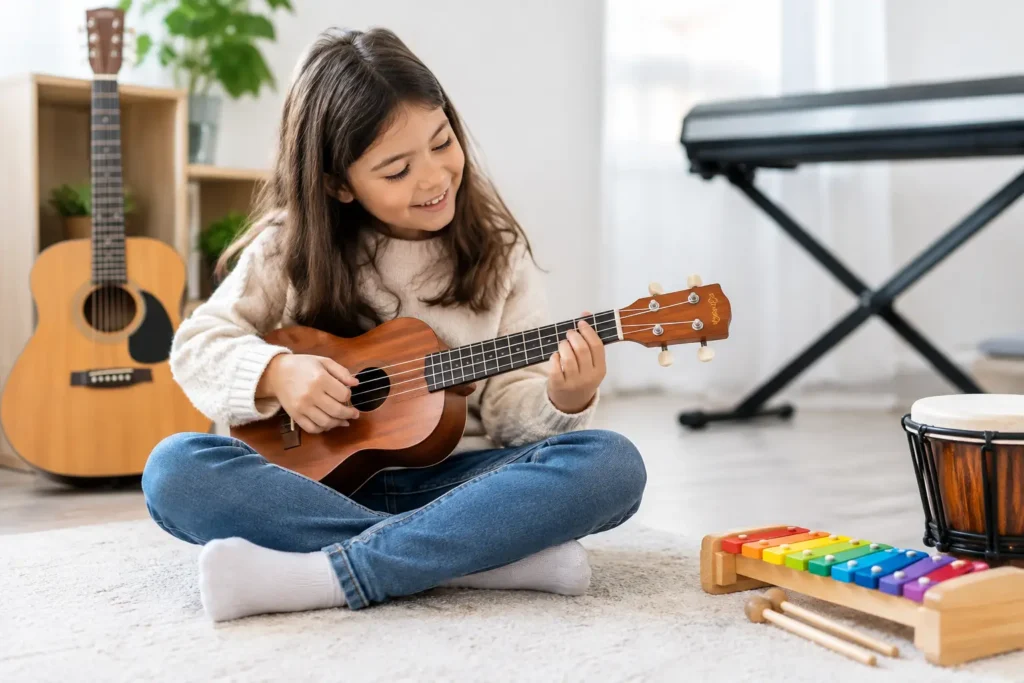
The ukulele is a particularly friendly introduction to fretted string instruments. Its four nylon strings are gentler on small fingers than steel guitar strings, its body is light, and a few simple chords can unlock a surprising number of songs. For children who want to sing as they play, that quick sense of accompaniment is hard to beat.
Guitar is equally appealing, especially for children inspired by bands and contemporary music. However, standard guitars can be physically demanding for very young players. A properly sized classical guitar with nylon strings is often a more comfortable first option than a full-size steel-string model. Fractional sizes make a real difference, so it is worth seeking advice rather than choosing solely by age on a box.
Both instruments encourage rhythm, listening and coordination. Ukulele is usually the easier route for a younger beginner, while guitar may be the better long-term fit for an older child with a clear enthusiasm for it.
Violin
The violin gives children a direct, expressive connection to sound. It comes in a wide range of fractional sizes, making it possible to begin much earlier than many parents expect. Young violinists learn careful listening, posture, bow control and pitch awareness from the beginning.
The trade-off is that the first sounds can be less immediately polished than those made on piano or keyboard. There are no fixed frets to guide the fingers, and producing a smooth tone with a bow takes patient practice. With encouraging teaching and a correctly fitted instrument, this challenge becomes part of the achievement rather than a reason to give up.
Violin can be ideal for children who are patient, attentive and attracted to orchestral music, film music or the idea of playing with others. A teacher should always check instrument size, shoulder rest and chin rest comfort as a child grows.
Drums and percussion
For children who naturally find the beat, percussion offers an exciting route into music. Drumming develops timing, coordination, listening and confidence, and it gives active learners a constructive way to use their energy. Lessons can begin with a practice pad, simple hand percussion or an electronic kit before moving to a full acoustic drum kit.
Electronic drums are often a sensible home option because their volume can be controlled with headphones. They do feel different from acoustic drums, though, and some children strongly prefer the physical response of real cymbals and drums. Practice pads are compact and excellent for technique, but they do not offer the same musical variety on their own.
Drums work especially well for children who enjoy movement and respond to rhythm before melody. Playing in a band or group can become a powerful goal as their skills grow.
Woodwind and brass
Flute, clarinet, saxophone, trumpet and trombone can all offer a rewarding musical path, but readiness is more individual here. A child needs enough physical reach, breath control and concentration to hold the instrument well and form the correct embouchure. For some, that may be at primary-school age; for others, waiting a little longer will make learning more enjoyable.
Clarinet is often a practical first woodwind choice because it is available in manageable sizes and gives clear note positions. Flute can suit children with sufficient arm length and a willingness to work on producing their first clear sound. Brass instruments are wonderfully social and expressive, but they need steady breath support and a comfortable mouthpiece fit.
If your child is drawn to the sound of a particular instrument, a short trial lesson is far more useful than guessing. Their teacher can assess physical suitability and suggest an appropriate route, including a smaller or alternative instrument where needed.
Singing
Voice is the instrument every child already owns. Singing lessons can be an excellent starting point for children who love songs, performance and storytelling but are not yet ready to choose an instrument. Good vocal tuition develops healthy technique, pitch, breathing, confidence and musical awareness without forcing a young voice to sound older than it is.
Singing can also sit alongside another instrument. A child who learns keyboard or ukulele while singing often gains a strong understanding of melody, rhythm and expression.
How to choose without putting pressure on your child
Start with what they listen to and imitate. Do they watch a pianist’s hands, air-drum to their favourite songs, hum orchestral themes or ask about a guitar? Their answer may change over time, and that is perfectly normal. Music lessons are a chance to explore, not a permanent contract with one instrument.
A taster lesson can remove much of the uncertainty. Children can hold the instrument, hear it played properly and experience the first steps with a supportive teacher. This is particularly valuable for violin, woodwind and brass, where fit and physical comfort are central to a positive start.
Avoid buying an instrument that is too large in the hope that they will grow into it. Poor sizing can affect posture and technique, and it can make practice uncomfortable. It is also wise to avoid the very cheapest options, which may be difficult to tune, poorly made or frustrating to play. A reliable beginner instrument, checked and set up properly, gives a child a fair start.
Building a routine that keeps music enjoyable
At the beginning, short and regular practice is more useful than occasional long sessions. Five focused minutes can be enough for a very young child; older beginners may gradually build towards longer sessions as they gain confidence. A consistent time after school or before tea can make practice feel like part of the day rather than a disagreement waiting to happen.
Parents do not need to be musicians to help. Notice effort, ask to hear a favourite piece, and keep the instrument accessible and ready to use. Progress will not always sound smooth. Squeaky violin notes, hesitant chords and uneven rhythms are normal signs of someone learning a new skill.
At Allegro Music Academy, experienced teachers help families find an instrument and lesson approach that suits the individual child, whether that means one-to-one tuition, a small group or live online learning. The aim is not to rush children towards perfection, but to give them a secure, encouraging start.
The best first instrument is the one that turns interest into a habit. Give your child room to try, time to improve and reassurance that every musician began with a first uncertain note.