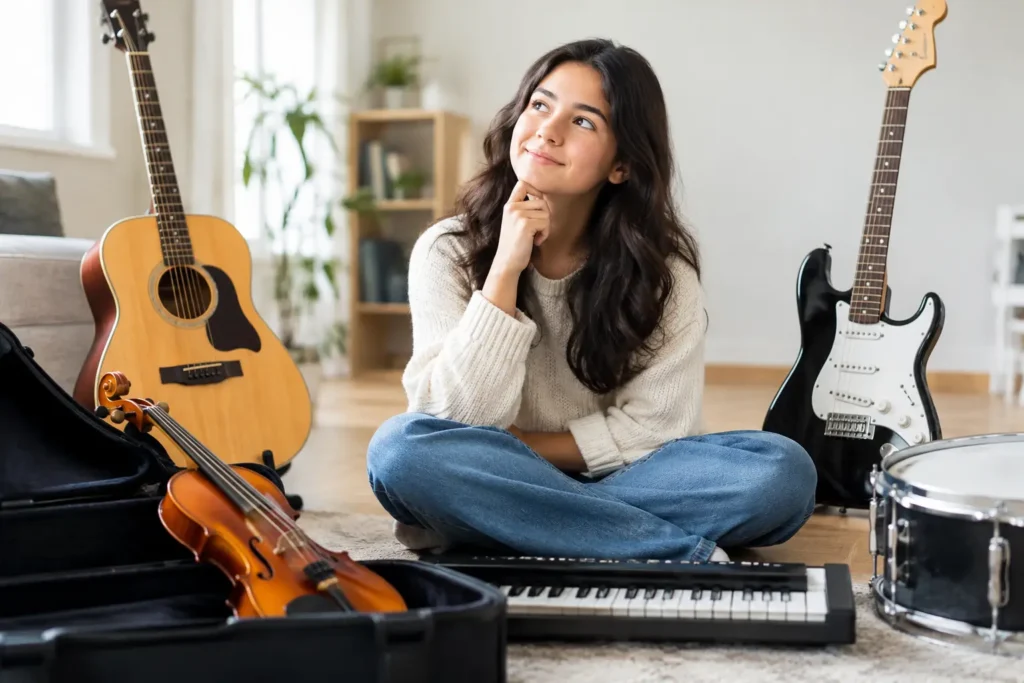
A child who keeps drumming on the kitchen table may not be asking for drums. An adult who loves a film soundtrack may not necessarily enjoy playing the violin. Working out how to choose first instrument is less about finding the ‘best’ option and more about finding one that feels exciting, comfortable and realistic to learn.
The right first instrument gives a new musician early wins: a recognisable tune, a satisfying sound and the feeling that progress is possible. That matters far more than choosing the instrument that seems most impressive or familiar. With thoughtful advice and a chance to try a few possibilities, learners of any age can make a confident start.
Start with the sound they genuinely enjoy
Musical taste is a useful clue. Ask what they listen to repeatedly, sing along with or notice in a favourite song. Someone drawn to pop, singer-songwriters or rock may connect quickly with guitar, keyboard, bass or vocals. A learner who loves orchestral music may be curious about violin, flute, clarinet or brass. For a person who notices rhythm before melody, drums could be a natural fit.
Try not to make the decision entirely on the music a child enjoys this month. Interests can change, particularly for younger learners. Instead, look for a broader pattern: do they enjoy singing? Are they fascinated by the beat? Do they prefer making up melodies, or are they patient with careful details? These small observations can point towards an instrument they will enjoy practising over time.
It is also worth separating the sound of an instrument from the experience of learning it. A violin can be beautiful in a concert, but the first sounds a beginner produces will be quite different. Equally, the piano offers an immediate, clear note from the first lesson, while guitar takes a little longer for fingers to become comfortable. Neither is better – they simply suit different personalities and expectations.
How to choose first instrument for the learner
Age, physical comfort and confidence all deserve a place in the decision. Young children need an instrument they can hold, reach and manage safely. Many instruments come in smaller sizes, including violins and guitars, so a professional assessment is far more helpful than guessing from age alone.
Piano and keyboard can be particularly approachable for children because the layout is visual and each key produces a sound easily. They also develop useful foundations in rhythm, melody and music reading. However, access to a suitable instrument for regular practice is essential. A keyboard can be a practical starting point in some homes, but key size, touch sensitivity and stability can affect how enjoyable it is to play.
Guitar and ukulele are popular because they are sociable, portable and work well with familiar songs. The ukulele’s smaller body and softer strings may feel more manageable for some younger players, while guitar offers a wider range of musical styles and a natural route into electric or bass guitar later on. Hand size, string pressure and the learner’s patience with early chord changes all make a difference.
Drums offer a physical, energetic route into music and build strong timing skills. They can be excellent for learners who find it hard to sit still for long periods. The practical question is whether there is an appropriate place to practise. Electronic kits and practice pads can help in some households, but they create a different playing experience from an acoustic kit.
Wind, brass and string instruments reward careful listening and steady technique. They can be wonderfully expressive, but they require learners to develop breath control, posture or bowing skills alongside reading music. A supportive teacher makes that process enjoyable and achievable, especially when the instrument has been selected and set up correctly.
Think about personality, not stereotypes
There is no such thing as a boys’ instrument or a girls’ instrument, nor is there an age when someone is too old to begin. Adults may be especially tempted to rule themselves out because they believe they have missed their chance. In practice, adults often bring focus, musical taste and the motivation to build a regular routine.
A quiet child may love the shared energy of drum lessons. A lively child may become completely absorbed in the concentration of violin. Let curiosity lead the conversation rather than assumptions about temperament.
Try before you commit
The most useful next step is usually to hold and hear the instrument in person. A learner can quickly tell whether an instrument feels awkwardly large, surprisingly heavy or immediately appealing. They may also discover an instrument they had not considered, such as clarinet, trumpet or bass guitar.
A first lesson or informal trial gives families something online videos cannot: expert observation. A specialist teacher can look at posture, hand position, reach and coordination, then explain what the first few months of learning are likely to involve. This makes it easier to choose an instrument with realistic expectations rather than relying on appearance alone.
At Allegro Music Academy, learners can explore a wide range of instruments with experienced teachers in a welcoming setting. That breadth is valuable when the answer is not obvious. A little guided experimentation at the beginning can prevent an expensive or discouraging mismatch later.
Be honest about practice at home
Every instrument needs regular contact, even if that begins with only a few focused sessions each week. Before buying, consider where it will live, when it can be played and who will help establish the routine for a younger learner.
Piano needs a dedicated space. Drums need consideration for household members and neighbours. Brass and woodwind need cleaning and careful storage. A guitar or ukulele is easy to pick up from a stand, which can encourage spontaneous practice, but it should still be kept safely. If an instrument is packed away in a difficult-to-reach place, it is much less likely to become part of everyday life.
For families with busy schedules, lesson format can matter too. One-to-one tuition offers individual attention, while small groups can be motivating for children who enjoy learning alongside others. Live online lessons can suit learners who need greater flexibility. The best arrangement is the one a learner can attend consistently and feel happy returning to each week.
Choose quality and suitability over unnecessary extras
A very cheap instrument can seem sensible when someone is just starting, but poor tuning, uncomfortable action or unreliable parts can make learning frustrating. This is particularly true for guitars, violins, brass and woodwind, where correct setup has a real effect on playability.
That does not mean a beginner needs professional-level equipment. It means they need an instrument that is the right size, works properly and is capable of producing a pleasing sound. Ask for specialist retail advice about suitable beginner models, essential accessories and whether renting, buying or choosing a pre-owned instrument makes most sense for your circumstances.
For some instruments, ongoing care is part of the commitment. Reeds, strings, sticks, rosin, cases and tuning all play a role. Knowing this in advance helps avoid small surprises and teaches learners to respect the instrument they are getting to know.
Leave room for the choice to change
The first instrument does not have to be the only instrument. Piano can lead naturally into keyboard, composition or music theory. Ukulele can prepare a learner for guitar. Drums can build the rhythmic confidence that supports any future instrument. Singing lessons can strengthen musical ear and confidence whether or not a learner later chooses another route.
Changing direction is not a failure. Sometimes a learner needs time to understand what they enjoy about music before they find their best match. The skills gained along the way – listening, coordination, perseverance and creative confidence – still belong to them.
Choose an instrument that makes the learner want to return tomorrow, not one that merely looks good on the first day. The joy of music grows through regular, encouraging moments of progress, and the right beginning makes those moments much easier to find.