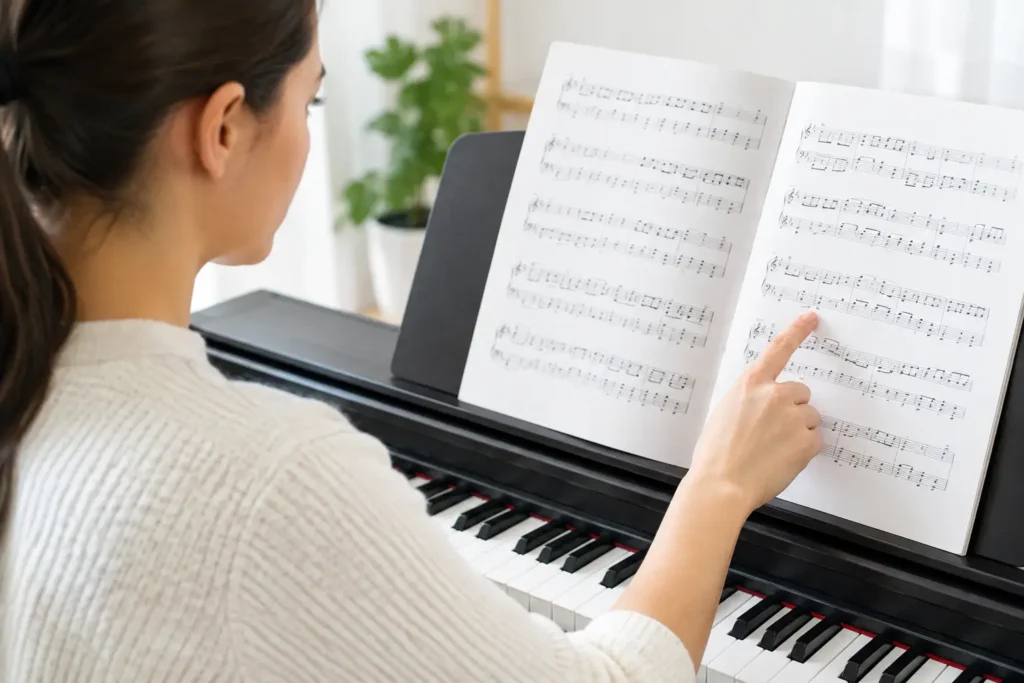
Sheet music can look like a new language at first: five lines, scattered dots, stems, flags and symbols that seem to demand instant understanding. The encouraging news is that nobody reads it all at once. This guide to reading sheet music breaks the page into manageable parts, so children, adult beginners and returning players can start turning notation into real music.
Reading music is a skill built through repetition, much like reading words. At the beginning, you may need to stop and work out each note. With regular practice, familiar patterns begin to stand out and your eyes learn to look ahead. That is when playing starts to feel more fluent, expressive and enjoyable.
Start with the stave and clef
Most written music sits on a stave, which is the set of five horizontal lines and the four spaces between them. Notes are placed on lines or in spaces to show their pitch: whether a sound is higher or lower.
The symbol at the beginning of the stave is called a clef. It tells you how to name the notes on those lines and spaces. The two clefs most beginners meet are treble clef and bass clef.
Treble clef
Treble clef is used for higher sounds. It is common in piano right-hand music, violin, flute, recorder, guitar, trumpet and vocal music. From the bottom line upwards, the notes are E, G, B, D and F. The spaces spell F, A, C, E.
Helpful memory phrases can be useful at first, but they are only a starting point. Rather than relying on a phrase forever, practise recognising notes by their position and by the distance between them. If one note moves from a line to the next space, it has moved by one step.
Bass clef
Bass clef is used for lower sounds. You will often see it in piano left-hand parts, bass guitar, cello, trombone and lower woodwind music. The bass clef lines, from bottom to top, are G, B, D, F and A, while the spaces are A, C, E and G.
Piano learners soon need both clefs, which can feel like a lot to take in. Take your time. A teacher may ask you to name notes away from the instrument, then find those same notes on the keyboard. This connects what you see with what you play.
Understand how long each note lasts
Knowing a note name is only half the job. Rhythm tells you when to play it and how long to hold it. At the start of a piece, you will usually see a time signature: two numbers written one above the other.
In a time signature of 4/4, there are four beats in each bar and a crotchet receives one beat. This is one of the most common time signatures, so it is an excellent place to begin. A minim lasts for two beats, a semibreve lasts for four, and two quavers usually fit into one beat.
Rests matter just as much as notes. They tell you when not to play. Beginners sometimes rush through rests because silence can feel like nothing is happening. In fact, rests create shape, breathing room and rhythm. Counting them carefully is part of playing with control.
Clap a rhythm before you play it. Say the count aloud, tap your foot steadily or use a metronome at a comfortable speed. If a rhythm is difficult, remove the pressure of finding pitches and focus on the beat first. Once the pattern feels secure, add the notes back in.
A guide to reading sheet music one bar at a time
A vertical line on the stave is called a bar line. The space between two bar lines is a bar, sometimes called a measure. Each bar should contain the correct number of beats for the time signature.
This gives you a reliable way to check your work. In 4/4 time, for example, every completed bar must add up to four beats. If it does not, pause and look again. You may have missed a rest, mistaken a note value or counted too quickly.
Do not try to decode a whole page before playing. Read one bar, or even a small group of notes, then play it slowly. Look for repeated rhythms, notes that rise or fall step by step, and sections that return later in the piece. Music is full of patterns, and spotting them makes reading much less daunting.
For younger learners, it can help to point along the music while counting. For adults, writing in every letter name may feel reassuring at first, but it can become a crutch if it stays on the page too long. Mark only the occasional difficult note, then gradually rely more on the stave itself.
Key signatures and accidentals
Just after the clef, you may see sharps or flats placed in a fixed pattern. This is the key signature. It tells you which notes are normally sharpened or flattened throughout the piece, until the key signature changes.
A sharp raises a note by a semitone. A flat lowers it by a semitone. A natural returns a note to its usual pitch. When one of these signs appears immediately before a note in a bar, it is an accidental. It normally applies for the rest of that bar to notes of the same pitch.
There is no need to memorise every key signature on day one. Begin by noticing what has changed. If there is one sharp in the key signature, make a habit of looking for every F and playing F sharp. Over time, keys will become familiar through the pieces you play and the scales you practise.
Look beyond the notes
Sheet music also tells you how the music should sound. Dynamic markings such as p for quiet and f for loud give your playing contrast. Slurs show notes to be played smoothly, while staccato dots ask for a shorter, lighter sound. A tie joins two notes of the same pitch, so they are held as one longer note.
Tempo words and markings set the pace. You may see Italian terms such as andante or allegro, or a metronome marking that gives a number of beats per minute. The right speed depends on your stage of learning. It is always better to play slowly with a steady pulse than quickly with hesitations and mistakes.
Expression markings are not decorations added after the hard work is done. They are part of the composer’s instructions. Even a simple beginner piece becomes more musical when you observe its dynamics, phrasing and articulation.
Make reading practice part of your routine
Short, frequent sessions are more effective than an occasional long struggle. Spend a few minutes reading something easier than your current performance pieces. This is often called sight-reading, and its purpose is not perfection. It trains you to keep going, maintain a pulse and recover calmly when a note is missed.
Before playing, take a brief scan of the page. Check the clef, key signature, time signature, starting hand position and any tricky rhythms. Then keep your eyes on the music as much as possible. Looking down at your hands is natural, especially on larger instruments or unfamiliar shapes, but try to return your attention to the page promptly.
For pianists, practise hands separately before bringing them together. Guitarists and ukulele players may see chord symbols as well as notation, while drummers read rhythm on a stave where each line or space represents a different part of the kit. The underlying principles remain the same, but each instrument has its own practical challenges.
A supportive teacher can make a significant difference here. They can choose music that is challenging without being discouraging, explain symbols in context and help you build dependable reading habits. At Allegro Music Academy, learners of every age and ability can develop these skills gradually in a welcoming, structured setting.
Give yourself permission to read slowly
Confident music readers are not people who never hesitate. They are musicians who have learned how to notice, count, listen and carry on. Celebrate the small signs of progress: recognising a note without thinking, keeping a steady beat through a full line, or returning to a piece that once looked impossible and finding it manageable.
The page will become less crowded with every piece you play. Keep the pulse steady, work in small sections and let curiosity lead the way. Soon, those black marks on five lines will begin to sound like music you can make your own.