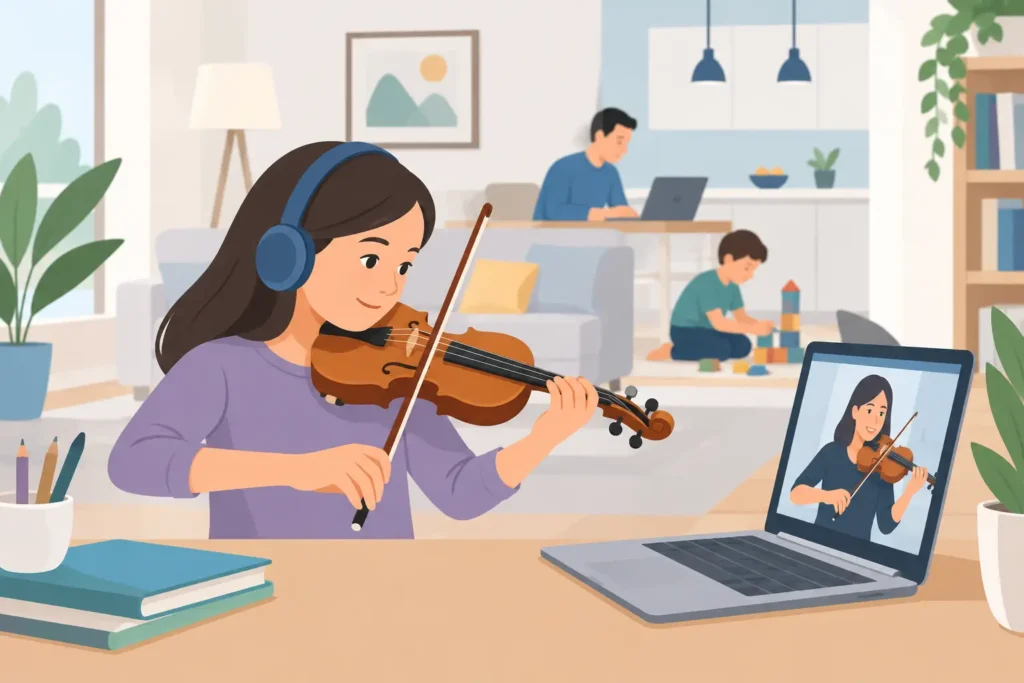
A piano lesson can happen before the school run. A teenager can fit in guitar tuition between revision and football practice. An adult can return to singing after the children are in bed. Online music lessons make these moments possible, bringing experienced, individual teaching into the place where practice actually happens: home.
For many families and adult learners, that convenience is the starting point. The real value is what it can support over time: regular learning, growing confidence and the joy of making music without the pressure of a difficult journey or a tightly packed evening. With the right teacher and a sensible routine, learning online can be every bit as focused, encouraging and rewarding as learners hope it will be.
What online music lessons can offer
Live online tuition is not simply a pre-recorded video or a library of exercises to work through alone. It is a real lesson with a specialist teacher, tailored to the learner’s instrument, experience and goals. A beginner might learn how to sit comfortably at the piano, hold a guitar pick or make their first clear sound on a woodwind instrument. A more experienced player may work on technique, repertoire, sight-reading, theory or preparation for an examination.
The teacher can hear how a piece is developing, demonstrate passages clearly and give immediate feedback. They can set manageable practice goals for the week ahead, then adapt the next lesson around what has gone well and where a learner needs more support. That personal relationship matters. It helps children stay motivated when a new skill feels difficult, and it gives adult beginners permission to learn at their own pace.
There is also a practical advantage to learning in the same room where practice will take place. A teacher can help a student think about posture, music stand height, lighting and how their instrument is positioned. Small adjustments can make practising more comfortable and productive.
Who benefits most from learning music online?
Online lessons can suit learners of almost any age and ability, but the best format depends on the person rather than the instrument alone. A confident teenager who already practises independently may enjoy the flexibility of a lesson at home. A younger child may thrive online too, particularly with a parent nearby to help with logging on, finding books and establishing a calm routine.
For adults, the appeal is often straightforward. Learning an instrument can be a welcome part of the week, yet work, family life and other commitments leave little room for travel. A regular online lesson turns an ambition that has been put off for years into something realistic. This is equally true for returning players who remember more than they expect, and for committed musicians who want consistent guidance around a busy timetable.
Some instruments translate particularly naturally to the screen. Piano, keyboard, guitar, bass, ukulele, vocals and music theory can work very well with thoughtful camera placement. Drums, violin, brass and woodwind lessons can also be taught successfully online, though learners may need a little more room and care in setting up their device so the teacher can see their playing position.
There are occasions when attending in person may be the better choice. Very young beginners sometimes benefit from more hands-on guidance, while ensemble playing and detailed work on an instrument’s physical setup are often easier face to face. Online and in-person learning do not need to be competing choices. Many students use one format consistently, while others switch when family routines, travel or learning needs change.
A good setup is simple, not elaborate
You do not need a studio at home to start. A reliable internet connection, a device with a camera and a quiet corner are usually enough. Place the device where the teacher can see both the learner and the instrument as clearly as possible. For a pianist, this may mean showing the keyboard and hands; for a guitarist or violinist, the camera should show posture as well as the fretting or fingering hand.
Headphones can improve sound in a busy household, although they are not essential for every lesson. What matters more is being able to hear and be heard without constant interruption. It is worth testing the camera and microphone a few minutes before the first session, especially if the lesson is for a child who may feel nervous about new technology.
Keep music, pencils, instrument accessories and water nearby. These small preparations avoid a rushed start and help the lesson feel like a dedicated musical appointment rather than another task squeezed into the day.
How to make online music lessons feel purposeful
The most successful online learners do not necessarily practise for long periods every day. They build a routine that is realistic enough to keep. Ten focused minutes on several days can be more valuable than one frustrated hour at the weekend, particularly for beginners developing coordination and note-reading.
Parents can help by making practice part of the household rhythm, without turning it into a battle. Ask a child to play their favourite part of the week’s piece, or sit nearby while they show you a new rhythm. Praise effort, listening and persistence rather than only a perfect performance. Music develops through repetition, and every player has weeks when progress feels quieter than expected.
Adults often need the same encouragement, even if they are less likely to ask for it. A missed practice session is not a reason to stop. Bring it up honestly in the next lesson, and a good teacher will adjust the plan. Perhaps a shorter exercise, a piece the learner genuinely enjoys or a clearer weekly target is what restores momentum.
It also helps to give lessons a personal purpose. One student may want to play a favourite song at a family gathering. Another may be working towards graded examinations, joining a band or building the confidence to sing in front of others. Goals can change, but having one gives practice a direction.
The role of a teacher still matters most
Technology makes online learning possible, but it does not replace teaching expertise. A skilled music teacher notices the details that can easily become habits: tense shoulders, uneven rhythm, unclear articulation, inefficient fingering or a learner who is losing confidence. They know when to simplify a task, when to challenge a student and when to celebrate progress that the student has overlooked.
That is especially reassuring for parents choosing tuition for the first time. The aim is not to create pressure or rush a child through levels. It is to develop sound musical foundations, curiosity and the confidence to keep going. For ambitious students, those foundations also support more advanced work later on.
At Allegro Music Academy, online tuition sits alongside private in-person lessons and small-group learning, giving families a choice that can evolve with them. Experienced teachers can help learners find a format that suits their age, instrument and aims, whether they are taking their first musical steps or returning to a much-loved hobby.
A flexible route into a lifelong love of music
Online learning works best when it feels connected, not distant. A familiar teacher, a clear plan and a regular slot in the week can create the structure learners need, while home keeps the experience relaxed and accessible. It is a practical option, but it can also be a genuinely personal one.
If learning music has been waiting for a quieter week, a shorter journey or a more convenient time, there may never be a perfect moment. A first lesson from home is often enough to turn good intentions into a musical routine that has room to grow.