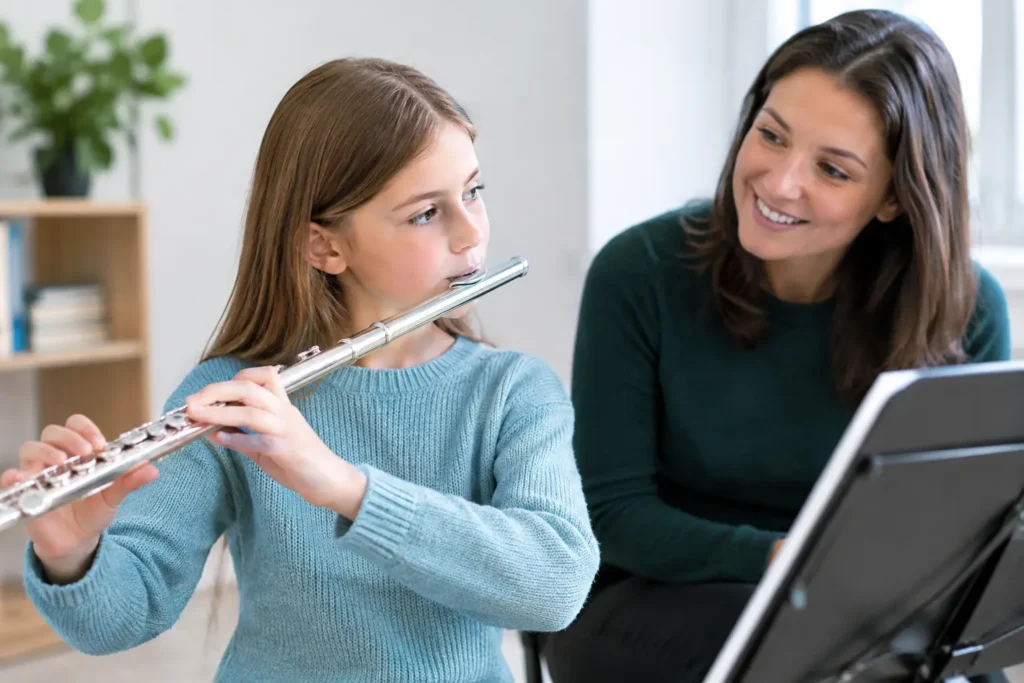
A child’s first clear flute note can feel like a small triumph – especially after the airy whispers and unexpected squeaks that often come first. Flute lessons for children Essex families choose should make room for both moments: the patient work of learning a new skill and the real excitement of hearing music begin to take shape.
The flute is a wonderful instrument for children who enjoy melody, like the idea of playing in a band or orchestra, or simply want an instrument with a bright, expressive sound. It can build concentration, listening skills and confidence, while giving a child a creative outlet that belongs entirely to them. The right start matters, however. Good teaching helps a young player develop sound technique without making lessons feel daunting.
Is the flute the right instrument for your child?
There is no single type of child who is suited to the flute. Some are naturally drawn to its sound after seeing it at school or hearing it in an ensemble. Others enjoy the practical challenge of coordinating their fingers, breathing and reading music. A child does not need to be outgoing, highly musical or already able to read notation to begin.
Physical comfort is the first consideration. A standard concert flute can be too long or too heavy for some younger children to hold comfortably. In that case, a curved-head flute can be an excellent starting point. Its shortened shape brings the instrument closer to the body, allowing smaller hands to reach the keys more easily. A teacher can advise on whether this is appropriate, rather than asking a child to struggle with an instrument that does not fit.
Age is only one part of the picture. Breath control, hand size, attention span and enthusiasm all matter. Some children are ready at an early primary-school age, while others benefit from waiting a little longer or beginning with another instrument first. The aim is not to rush. It is to give each learner a start that feels comfortable and encouraging.
What children learn in flute lessons
At the beginning, flute playing is about far more than getting through a tune. Children learn how to assemble and care for the instrument, hold it with good posture and produce a steady sound. This takes time. Unlike instruments where a note sounds as soon as a key is pressed, the flute asks the player to shape the air carefully at the mouthpiece.
A specialist teacher breaks this process into manageable steps. A child might first explore breathing games, make sounds on the headjoint alone, then gradually add finger patterns and short pieces. This approach prevents the early weeks from becoming frustrating. Small successes are noticed, repeated and built upon.
As confidence grows, lessons introduce rhythm, pitch, notation and musical expression. Children begin to understand that a piece is not simply a set of notes to get right. They learn to listen for smooth phrasing, changes in volume and the character of a melody. These are useful musical habits whether they continue with the flute for years or later play another instrument.
Progress is personal, not a race
It is easy for parents to wonder how quickly their child should move through books, grades or pieces. In practice, progress is rarely a straight line. One child may pick up reading quickly but need more time to develop a secure tone. Another may play confidently by ear before they feel comfortable with notation.
A thoughtful lesson plan responds to that individual pattern. It offers enough structure for a child to see that they are improving, but avoids treating every learner as though they must reach the same milestone at the same moment. Examinations can be a rewarding goal for some pupils, while others are happiest learning favourite tunes, preparing for a school performance or playing for the enjoyment of it.
Choosing flute lessons for children in Essex
When looking for flute lessons for children in Essex, parents often want reassurance on two levels. They want a teacher with genuine subject knowledge, and they want an environment where their child will feel settled enough to try, make mistakes and keep going.
A flute teacher should understand the technical foundations of woodwind playing as well as the needs of younger learners. Clear demonstrations, patient explanations and carefully chosen music make a considerable difference. Lessons should be challenging enough to hold a child’s interest, but never so pressured that music becomes another source of worry in an already busy week.
The setting matters too. Purpose-built teaching rooms, a well-organised approach and regular lesson availability help families establish a reliable routine. For some, one-to-one tuition is the best fit because it gives a child focused attention and a pace tailored to them. Others may enjoy the social encouragement of a small group, where appropriate. Live online lessons can also be useful for families whose schedules make travelling difficult, provided the child has a suitable space and an adult nearby to help at the start.
At Allegro Music Academy, children can learn with experienced specialist teachers in welcoming academy settings across Essex. The focus is on helping each pupil enjoy the process while gaining the skills to make satisfying, lasting progress.
Practice that works in family life
Regular practice is valuable, but it does not need to mean a long daily battle. In the early stages, short and focused sessions are usually more effective than trying to do too much at once. Five minutes spent producing a clear, relaxed sound and revisiting one small section can be more useful than half an hour of distracted playing.
The most helpful routine is often the one that is easiest to repeat. Choosing a consistent time after school, before tea or as part of a weekend routine can remove the need for daily negotiation. Keeping the flute assembled safely nearby, with the music stand ready, also makes practice feel less like a major task.
Parents do not need to become flute teachers. Their role is to provide encouragement, notice effort and create the opportunity to practise. Asking a child to play their newest piece, or simply listening to a few minutes of sound practice, shows that their work is valued. If practice has become difficult, it is worth mentioning it in the next lesson. A teacher can often simplify the task, suggest a different routine or identify a technical issue that is making a piece feel harder than it should.
Buying and caring for a first flute
A first instrument should be dependable and comfortable rather than chosen solely because it is the cheapest available option. Poorly made flutes can leak, stick or be difficult to play in tune, which makes early learning unnecessarily discouraging. The right model depends on a child’s size, stage and likely commitment, so practical advice is worthwhile.
It is also sensible to think about the essentials around the instrument: a suitable case, cleaning rod, cloth and music stand all help establish good habits. After playing, moisture should be removed from inside the flute and the instrument stored safely in its case. Keys need gentle handling, and the flute should never be left in a very hot, cold or damp place.
Like any precision instrument, a flute benefits from occasional professional attention. A small adjustment can make a noticeable difference to response and sound. Families who can access both tuition and knowledgeable instrument servicing have the reassurance that advice is available as their child develops.
The confidence that grows beyond the lesson
Learning flute is not only about becoming technically capable. It gives children a regular experience of working at something, listening carefully and seeing improvement over time. A piece that once seemed impossible becomes familiar. A hesitant sound becomes clearer. Eventually, a child may perform for family, play alongside friends or take part in a school ensemble.
Those moments are valuable because they are earned. They teach a young musician that confidence is not something they either have or lack – it is something that can grow through steady, supported effort.
If your child is curious about the flute, the best first step is simply to let them try it in a calm, encouraging setting. With an instrument that fits, a teacher who understands how children learn and time to enjoy each small achievement, the joy of music has every chance to become a lifelong companion.