A child has practised their first chord all week and cannot wait to show their teacher. An adult learner has finally found a free hour after work. In both cases, the question is the same: are online lessons effective when learning an instrument? With the right teacher, a suitable set-up and a learner who is ready to engage, they can be a genuinely rewarding way to make musical progress.
Online tuition is not simply an in-person lesson moved on to a screen. It works best when it is treated as its own format, with clear communication, focused goals and regular practice between sessions. For some learners, it offers the flexibility that makes lessons possible in the first place. For others, especially at the earliest stages or when preparing for demanding performance goals, face-to-face teaching may bring advantages that are hard to replace.
Are online lessons effective for every musician?
Online lessons can be effective for children, teenagers and adults, from complete beginners through to experienced players. A skilled teacher can demonstrate technique, listen carefully to rhythm and tone, set suitable music, answer questions and adapt the lesson to the learner in front of them. Screen-sharing can also make it easy to look at notation, chord charts and theory exercises together.
The strongest results tend to come from a good match between the learner, instrument and lesson format. Piano, keyboard, guitar, bass, ukulele, singing and music theory often work particularly well online because the teacher can clearly see the player’s hands, posture and music. Many woodwind, brass, violin and drum students can also learn successfully remotely, although camera position and sound quality become more important.
A live online lesson is still a lesson with a real specialist teacher, not a pre-recorded course to work through alone. That distinction matters. Personal feedback helps learners correct small issues before they become habits, and it gives practice a clear purpose from one week to the next.
What makes remote music tuition work well?
The most valuable part of any lesson is the relationship between teacher and learner. A supportive teacher notices what is improving, explains what needs attention and keeps the next step achievable. That remains true online.
For younger children, a parent or carer can help at the start of the lesson by checking that the instrument, music and device are ready. They do not need to become a second teacher. Simply being nearby when needed can help a child settle in and maintain a positive routine.
Adults often appreciate the privacy and convenience of learning from home. There is no need to fit travel around work, family commitments or a busy weekend. This can make it easier to maintain regular tuition, and regularity is one of the most reliable foundations for progress. A short, focused practice session several times a week will usually achieve more than an occasional long session.
Online lessons are particularly useful when they remove a barrier that might otherwise stop someone learning. Illness, poor weather, limited transport or a changing schedule do not have to mean losing momentum. For families in Essex, online tuition can also be a practical complement to academy-based lessons when getting to Chelmsford, Southend or Colchester is not convenient on a particular day.
A simple home set-up is enough
You do not need a studio full of equipment to learn well online. A reliable internet connection, a laptop or tablet, and a reasonably quiet, well-lit space are a good starting point. Headphones may be helpful for some instruments, but they are not always essential.
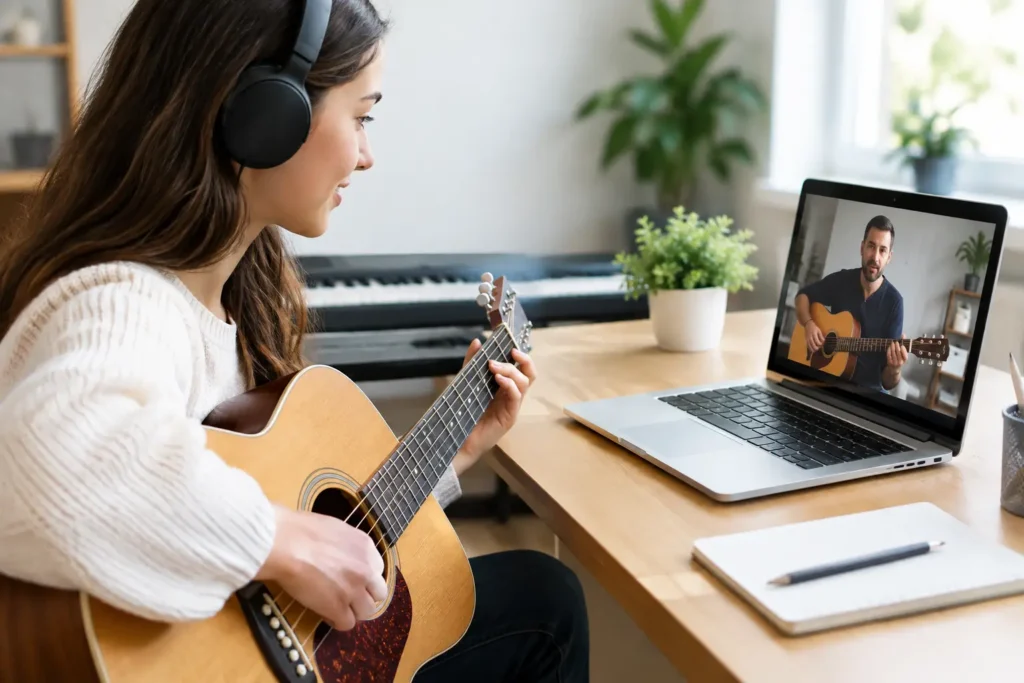
Position the camera so the teacher can see the relevant part of the instrument and the learner’s posture. A pianist may benefit from a view of the keyboard and upper body; a guitarist should make sure both hands are visible; a singer needs enough space for the teacher to observe breathing and stance. It may take a few minutes to find the best angle, but this small adjustment can make feedback much more precise.
Keep music, a pencil and any accessories close by before the lesson starts. That creates a calmer beginning and protects valuable teaching time. For beginners, tuning an instrument beforehand, where appropriate, is another helpful habit. Teachers can guide learners with tuning, but a well-prepared instrument lets the lesson begin with music rather than troubleshooting.
The benefits that matter most
Flexibility is the obvious benefit, but it is not the only one. Learning at home can help some students feel more relaxed, especially if they are nervous about starting a new instrument. They are already in a familiar environment, with their own instrument and usual practice space.
That familiarity can improve practice, too. During the lesson, the teacher sees the exact set-up the learner will use during the week. If a music stand is too low, the seating position is uncomfortable or a player is struggling to organise their books, these practical issues can be addressed immediately.
Online tuition can also encourage independence. Learners become accustomed to listening closely, following written notes and taking responsibility for preparing between lessons. These are valuable musical skills at every level, from a child learning their first tune to an advanced student refining a recital piece.
For adults returning to music after a long break, remote lessons can feel like a manageable way back in. There is no expectation to arrive already polished. A good teacher will meet the learner where they are, building technique and confidence gradually while keeping the joy of music central.
Where in-person lessons may be better
There are times when a purpose-built teaching room provides a clearer advantage. Very young beginners may respond better to the focus and energy of learning in person. Some physical techniques are also easier to demonstrate and assess face to face, particularly where detailed hand position, embouchure, bow hold or body alignment is involved.
Sound can be another consideration. Video calls compress audio, so the teacher may not hear every subtle detail of tone, dynamics or ensemble balance. This does not prevent productive online teaching, but it can make in-person sessions preferable for advanced performers working on fine musical detail.
Students preparing for examinations, auditions or performances may choose a blend of formats. Online lessons can maintain consistency and support regular progress, while occasional in-person tuition offers concentrated work on presentation, technique and performance confidence. The best choice is not about which format is universally superior. It is about what gives the learner the most consistent, encouraging and effective support.
How to get more from online music lessons
Progress is rarely about talent alone. It grows from clear teaching, realistic goals and the willingness to return to the instrument regularly. Before each lesson, think of one thing that went well in practice and one thing that felt difficult. This gives the teacher a useful starting point and helps the learner take an active role.
After the lesson, write down the key practice points while they are fresh. A teacher may set a scale, a section of a piece, a rhythm exercise or a listening task. Breaking that work into small sessions makes it feel less daunting and helps improvement become noticeable. Children often respond well to a predictable practice time, while adults may prefer to build practice around existing routines such as after dinner or before work.
It is also worth being honest if something is not working. Perhaps the camera angle is unhelpful, the chosen piece feels too difficult, or home is too distracting at a certain time of day. A flexible teacher can adjust the approach. Music tuition should challenge a learner, but it should not leave them feeling overwhelmed.
Choosing the format that keeps you learning
The most effective lesson is often the one a learner can attend consistently, enjoy and build on each week. For some, that will be a live online session from home. For others, it will be the motivation of visiting an academy, meeting a teacher in person and learning in a dedicated musical environment. Many learners benefit from having both options available as life changes.
At Allegro Music Academy, every learner can be taken seriously whatever their age, instrument or starting point. Whether online tuition becomes your regular routine or a useful part of a wider learning plan, the aim remains simple: steady progress, growing confidence and a lifelong love of music. The best next step is the one that makes picking up your instrument feel possible again this week.