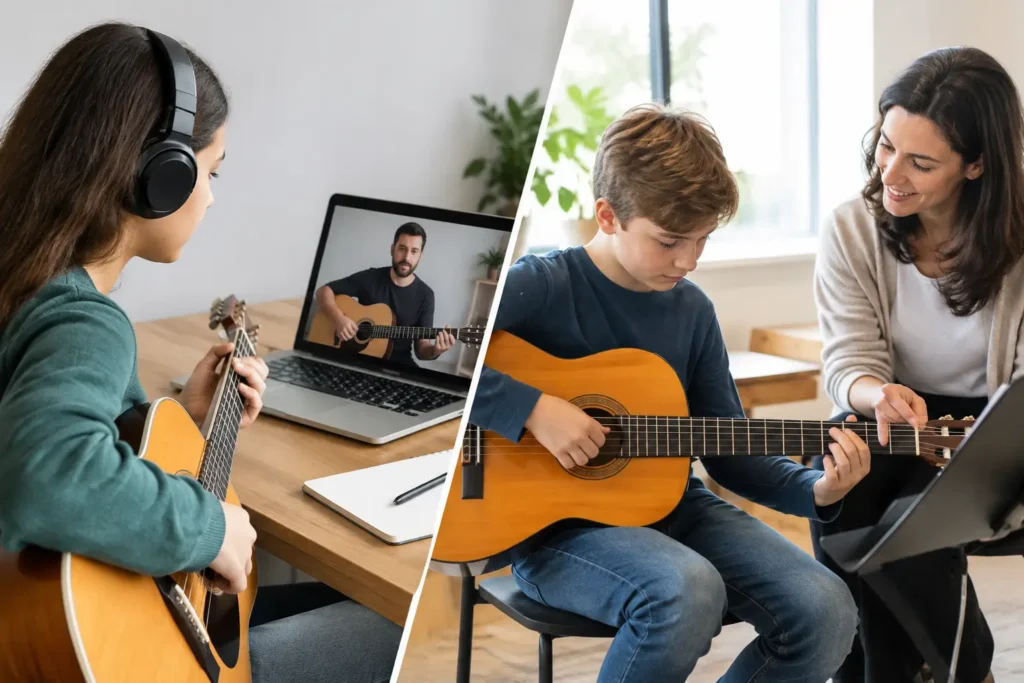
A piano stool that is too low, a guitar held at an awkward angle or drumsticks gripped too tightly can slow early progress without a learner quite knowing why. That is why the choice between online versus in-person instrument tuition is about more than convenience. Both can be enjoyable, effective ways to learn, but each gives a teacher different opportunities to support technique, confidence and musical independence.
For a child beginning their first notes, an adult returning to music after years away, or a committed player preparing for an exam, the right format is the one that makes regular learning feel realistic and rewarding. The question is not which is universally better. It is which setting will help this particular learner keep going.
Online versus in-person instrument tuition: the main difference
Live online lessons bring the teacher into the learner’s home through a video call. In-person lessons take place in a dedicated teaching room, with teacher and student sharing the same musical space. The teaching goals can be very similar: learning pieces, reading music, developing technique, building aural skills and enjoying the process. The practical experience, however, is different.
Online tuition is especially useful when travel is difficult, family schedules are full or a learner simply feels more comfortable starting in familiar surroundings. A good online lesson still has structure, feedback and accountability. The student plays, listens, asks questions and receives clear targets for the week ahead.
In-person tuition offers direct, immediate observation. A teacher can hear the natural sound of an instrument in the room, demonstrate details from close by and make small adjustments to posture or hand position before they become habits. For many beginners, particularly younger children, that shared focus can make the first stages feel more engaging and easier to understand.
Neither option removes the need for practice. What strong tuition does is make practice clearer, more purposeful and more enjoyable.
When online lessons are a very good fit
Online learning can suit learners of many ages and abilities. It is not a lesser version of a lesson when it is planned well and the student has a suitable space to work in. For independent teenagers, busy adults and returning musicians, the ease of joining a lesson from home can be the difference between continuing with music and putting it off for another year.
It also gives parents a useful window into a child’s learning. A parent may hear the teacher explain how to practise a tricky bar, how to count a rhythm or why a particular hand shape matters. That makes it easier to encourage helpful practice between lessons, without needing musical knowledge themselves.
Online tuition works particularly well for piano, keyboard, guitar, ukulele, bass, music theory and vocals, where a carefully positioned camera can show both player and instrument clearly. It can also be effective for many orchestral, brass and woodwind instruments, provided the teacher can see the student’s setup and hear them well enough to offer detailed feedback.
The home setting has another advantage: students learn on the instrument they will practise on every day. A teacher can spot whether the piano bench is at an appropriate height, whether a music stand needs adjusting or whether the learner is struggling with a practical issue at home. Small changes to the setup often make practice more comfortable.
There are limits. Video calls cannot fully reproduce the richness, balance and volume of live sound. Internet delay means teacher and student cannot reliably play in time together, which matters for duets, accompaniment and ensemble-style work. Younger children may also find it harder to concentrate through a screen, especially if the household is busy.
A simple online setup makes a difference
Online lessons do not need a studio full of equipment. A reliable internet connection, a charged device with a camera, good lighting and a quiet corner are usually enough to begin. The most helpful improvement is camera placement: the teacher needs to see the player’s face, hands and as much of the instrument as possible.
For piano or keyboard, a side view that includes hands and posture is often useful. Guitarists and violinists may need the camera positioned far enough back to show the full instrument. Headphones can improve speech clarity, although musicians should avoid settings that cut out sustained notes or change the sound too heavily.
Before the first lesson, allow time to test the connection and find an angle that works. It is a small bit of preparation that helps the lesson feel relaxed from the start.
Why in-person tuition remains valuable
There is something reassuring about walking into a well-prepared music room, meeting a teacher face to face and having a regular time that is reserved for music. For children, that routine can create a welcome boundary between home, school and focused creative activity. For adults, it can provide protected time in a busy week.
In-person lessons are often the strongest choice when a learner needs close support with physical technique. This can be especially helpful in the early stages of violin, brass, woodwind and drums, where body position, breathing, embouchure, stick control and instrument setup all affect the sound. A teacher can demonstrate, listen from different positions in the room and respond to the detail they hear.
The live experience is also valuable for learners who are motivated by connection. Playing alongside a teacher, clapping rhythms together or hearing an accompaniment in the room can make music feel immediate rather than theoretical. Small-group classes add another dimension, helping students listen, take turns and gain confidence alongside other learners.
Purpose-built teaching rooms provide appropriate instruments and fewer everyday distractions. This can be helpful for a family still deciding whether an instrument is the right fit, or for a student who needs access to equipment that is not practical to keep at home. At Allegro Music Academy, specialist teachers and welcoming teaching spaces help learners build skills without the pressure of an overly formal environment.
In-person tuition does require travel and a fixed journey in the weekly routine. For some families, that commitment is worthwhile because it supports consistency. For others, it is precisely the obstacle that makes online lessons the more sustainable choice.
Choosing the right format for your learner
Start with practicalities, but do not stop there. Ask how the learner responds to new situations. Do they enjoy meeting people and benefit from hands-on guidance? An in-person lesson may give them the confidence to settle in quickly. Are they self-motivated, short on time or likely to practise more reliably when lessons happen at home? Online learning may be an excellent match.
Age is relevant, but personality matters more. Some younger learners thrive online when a parent helps them get ready and remains nearby if needed. Some adults prefer attending in person because the journey creates a sense of occasion. A confident, advanced student may choose either format depending on their timetable and goals.
The instrument matters too. A beginner drummer may gain a great deal from seeing technique demonstrated in person, while a pianist with a suitable instrument at home may progress very comfortably online. A vocalist can work effectively in either setting, though live tuition can be useful when exploring projection, breathing and performance presence.
It is also worth considering what success looks like. If the goal is a relaxing hobby, convenience may be the priority. If a learner is working towards examinations, auditions or advanced performance, regular detailed feedback and a dependable practice plan become especially important. Both formats can support serious progress when the teacher, student and family communicate clearly.
A blended approach can offer the best of both
Learning needs change. A student may begin with in-person lessons to establish good foundations, then move online during a busy school term. An adult who normally learns online may arrange occasional face-to-face sessions to focus on technique or prepare for a performance. There is no need to treat the decision as permanent.
A blended approach can also make missed travel time less disruptive. If circumstances occasionally prevent a visit to the academy, an online lesson may help preserve momentum. Musical development tends to come from steady contact with the instrument, not from waiting for the perfect week.
Whichever format you choose, look for tuition that feels personal rather than mechanical. The right teacher will listen to what the learner enjoys, set achievable challenges and adapt the lesson as confidence grows. A child who loves film music, an adult drawn to blues guitar and a young musician aiming for grades all deserve teaching that takes their ambitions seriously.
The best next step is a simple one: choose the setting in which you or your child will feel comfortable turning up, asking questions and practising between lessons. Confidence rarely arrives before the first note. It grows through patient guidance, regular effort and the continuing joy of hearing yourself improve.