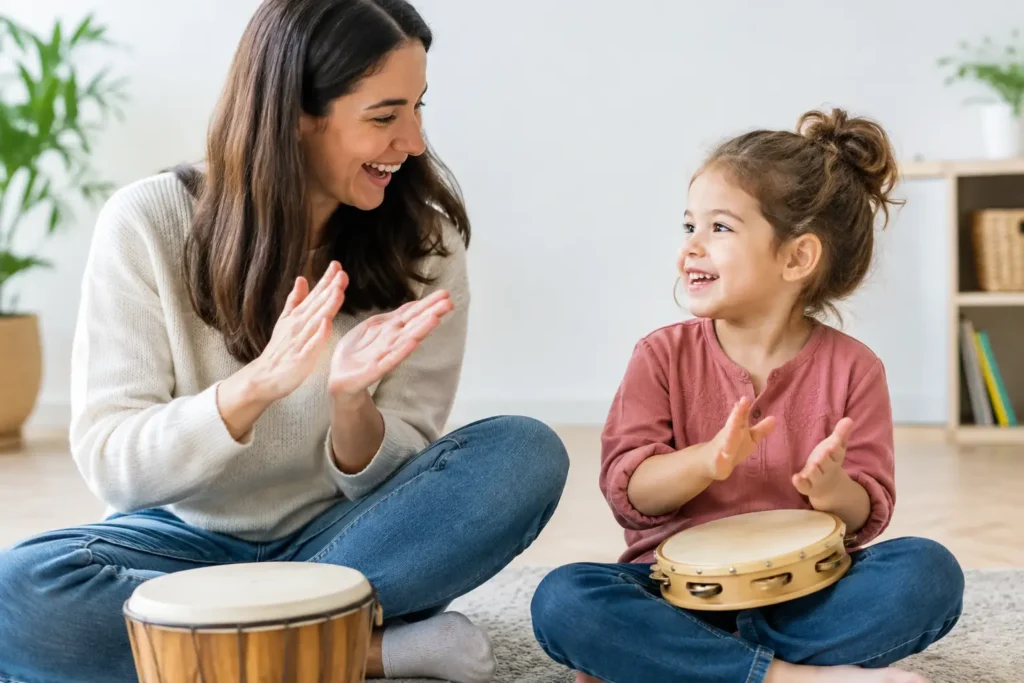
A child who taps along to a favourite song, marches through the kitchen or turns a saucepan into a drum is already experimenting with rhythm. Knowing how to teach child rhythm is less about correcting every beat and more about helping them notice, feel and enjoy the steady pulse that makes music move.
Rhythm is often one of the first musical skills children can experience physically. Before they can read notation or name a crotchet, they can clap, step, shake and copy. These early experiences build listening, co-ordination, concentration and confidence – all valuable foundations for future music lessons.
Start with a steady beat, not complicated patterns
The beat is the regular heartbeat of a piece of music. For younger children, this is the best place to begin. Put on a song with a clear, moderate pulse and invite your child to clap once every time they hear the beat. If clapping is tricky, try tapping knees, stamping feet or passing a soft ball from hand to hand.
Choose music they genuinely enjoy. Familiar nursery rhymes, action songs and simple pop songs can all work well, provided the pulse is easy to hear. The aim is not perfect timing straight away. It is for your child to recognise that the beat keeps going, even when the melody changes.
Keep activities short. Two focused minutes are far more useful than ten minutes of frustration, particularly for preschool-aged children. Finish while the game still feels successful, then return to it another day.
How to teach child rhythm through movement
Children learn rhythm with their whole bodies. Movement makes an abstract musical idea immediate: fast feels like running, slow feels like stretching, and a steady beat feels like walking.
Try walking around the room to a regular pulse. When the music stops, freeze. When it starts again, continue walking in time. You can then vary the game by asking your child to march heavily like an elephant, tiptoe lightly like a mouse or bounce like a ball, while keeping the same underlying beat.
This distinction matters. A child may be able to move quickly without staying in time. Help them listen for the pulse first, then match their movement to it. There is no need to use technical language at this stage. Phrases such as “Can you make your feet land with the music?” are clear, encouraging and practical.
For children who find large movements overwhelming, use smaller actions instead: tapping a finger on a table, rocking side to side or gently squeezing a beanbag. Rhythm should feel accessible, not like a test of physical confidence.
Use copying games to develop listening
Call-and-response games are one of the most effective ways to develop rhythm. Clap a short pattern, pause, and ask your child to clap it back. Begin with only two or three sounds, such as clap-clap, clap, then gradually introduce longer patterns when they are ready.
Use everyday words to make patterns memorable. “Ap-ple” gives two quick sounds, while “ba-na-na” gives three. Names are useful too: “Ja-cob”, “Em-i-ly” or “Al-le-gro”. Say the word, clap its natural rhythm, then invite your child to copy it.
At first, keep a clear gap between your turn and theirs. Once they are comfortable, try taking turns without stopping the beat. This is more challenging because they must listen, remember and respond while maintaining a pulse. If it falls apart, simply return to the easier version. Progress in rhythm is rarely a straight line.
Make household percussion part of play
You do not need a full drum kit to explore rhythm at home. Wooden spoons on an upturned plastic tub, a homemade shaker filled with rice, or hands on knees can provide plenty of variety. The sound matters less than the opportunity to listen and respond.
Set a few simple ground rules before starting: instruments are played gently, only when invited, and never near anyone’s ears. Children often enjoy being given a turn as the leader. Ask them to make a pattern for you to copy. Being listened to can be just as motivating as learning to listen.
Add rhythm words before notation
Written rhythm is useful, but it should follow sound and movement rather than replace them. A child who has experienced a beat in their body will find musical notation much easier to understand later.
You might say “walk” for one sound on each beat and “run-ning” for two quicker sounds within a beat. Some teachers use food words, animal sounds or made-up syllables. The exact system matters less than using it consistently and ensuring your child can hear the difference between long, even sounds and shorter, quicker ones.
When they are ready, draw simple symbols together. A row of circles can represent steady beats. Two small dots inside one beat can show two quicker sounds. Ask your child to point, clap and then play the pattern. This turns notation into a picture of something they already know, rather than a puzzle to decode.
Avoid rushing towards worksheets if your child is still happiest moving and copying. Older children may enjoy the visual challenge sooner, while younger learners often benefit more from repeated musical games. It depends on their age, attention span and previous experience, not simply on how quickly they can count.
Practise rhythm little and often
Rhythm improves through regular, enjoyable repetition. Build it into ordinary moments: clap the syllables of words while preparing tea, tap a pulse while waiting for the kettle, or march to the front door before school. These small moments help children connect music with everyday life.
If your child is beginning an instrument, use rhythm away from the instrument as well as at it. A beginner pianist may be concentrating so hard on finding notes that the pulse disappears. Clapping or speaking the rhythm first frees them to focus on one skill at a time. The same approach helps guitarists, drummers, violinists and singers.
A metronome can be helpful for some children, especially once they are playing short pieces, but it is not always the best first tool. Its click can feel impersonal or pressurising. Start with songs, games and a parent or teacher keeping the beat. Introduce a metronome gradually when your child understands that it is a friendly guide, not a judgement.
Notice what your child is finding difficult
Children can struggle with rhythm for different reasons. Some cannot yet hear the beat clearly beneath a busy tune. Others hear it but find co-ordinating hands and feet difficult. Some become self-conscious when asked to perform alone.
Respond to the difficulty you can see. If listening is the challenge, simplify the music and tap along beside them. If co-ordination is difficult, return to one action, such as knee taps. If confidence is low, join in and make mistakes cheerfully yourself. A relaxed adult response tells a child that learning music is allowed to be messy.
Praise specific effort rather than vague results. “You kept going even when the pattern changed” or “I heard you find the beat again” helps a child understand what they have achieved. It also encourages resilience when a more difficult pattern arrives.
When a music teacher can help
Home activities give rhythm a wonderful, informal start, but a skilled teacher can spot habits that are hard for families to identify. They can choose material at the right level, introduce notation at the right moment and connect rhythmic understanding to an instrument your child wants to play.
At Allegro Music Academy, specialist teachers use individual lessons and small-group learning to make rhythm practical, musical and enjoyable. A child may discover their strongest sense of pulse through drums, piano, singing, violin or another instrument entirely. There is no single route into music, and a supportive lesson environment gives them room to find theirs.
The most valuable thing you can offer is permission to enjoy the process. Put music on, join the clapping, and let your child lead a rhythm game now and then. A steady beat learned through laughter can become the beginning of a lifelong love of music.