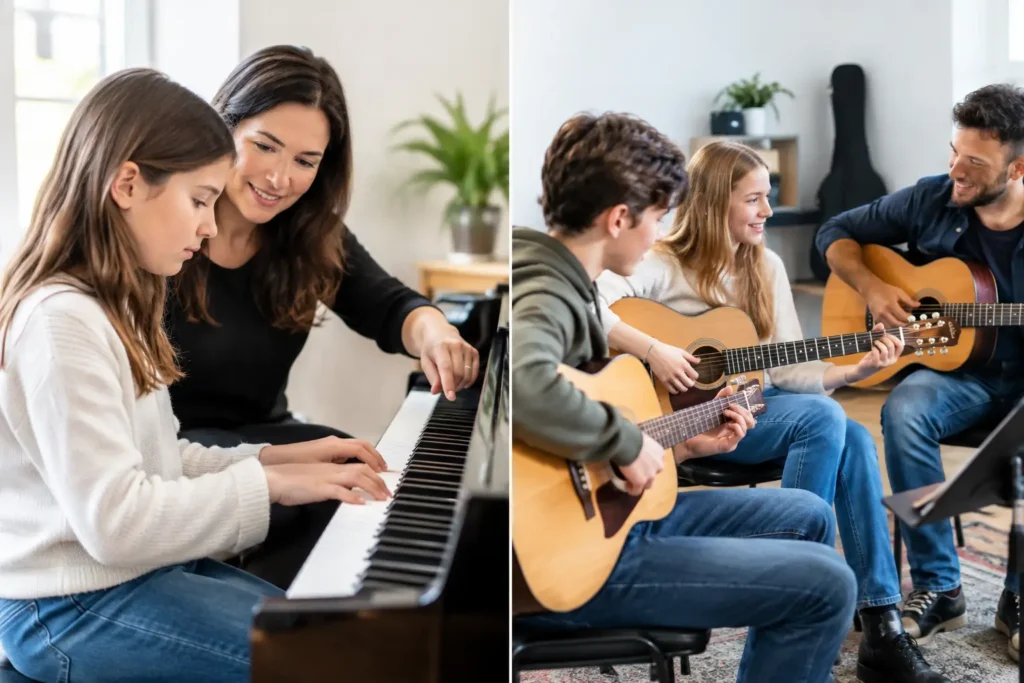
Choosing a lesson format can shape how a musician feels about learning from the very first week. When considering private versus group music tuition, the best choice is rarely about which option is ‘better’ overall. It is about the learner’s age, personality, goals, instrument and the sort of encouragement that helps them keep going when a new skill feels tricky.
Some learners flourish with a teacher’s full attention and a pace built entirely around them. Others find their confidence grows faster when they are part of a friendly class, sharing a laugh, a rhythm and the satisfaction of getting a piece right together. Both routes can lead to real musical progress and a lifelong love of music.
What private music tuition offers
Private one-to-one lessons give a student dedicated time with their teacher. Every activity can be chosen for that individual: the songs they enjoy, the techniques they need to develop and the goals that matter to them. For a child working towards an exam, an adult returning to piano after many years, or a guitarist keen to improve a particular style, that focus can be particularly valuable.
The pace is also highly flexible. A learner who quickly understands notation can move forward without waiting, while someone who needs more time with hand position, rhythm or reading music can practise the same skill in a calm, unhurried setting. This makes private tuition well suited to complete beginners as well as advanced players preparing for performances, auditions or qualifications.
Personal feedback at the right moment
In music, small details make a difference. A teacher may notice a tense wrist at the piano, an inefficient drum grip, a breath-control issue in singing, or a violin bow that needs a slight adjustment. In a one-to-one lesson, feedback can be immediate and practical, helping good habits form early.
Private lessons also make room for a more individual conversation. A teacher can understand what motivates the student, whether that is playing favourite songs, building confidence for a school performance, passing a grade or simply making time for a rewarding hobby. For some children, especially those who are shy or easily distracted, this concentrated support creates a reassuring place to try, make mistakes and improve.
When one-to-one learning may be the right fit
Private tuition often works well where a student has specific goals, an uneven level of experience, or a timetable that requires flexibility. It can be ideal for instruments with a strong technical foundation, such as piano, violin, brass or woodwind, where individual posture and sound production benefit from close guidance.
That does not mean lessons need to feel intense. The best one-to-one teaching balances structure with enjoyment. A seven-year-old learning keyboard may progress through games, familiar tunes and simple rhythm activities, while an adult singer may work on breathing, range and songs they genuinely want to perform. The teacher meets the learner where they are, then gives them a clear next step.
The strengths of group music tuition
Group lessons bring a different kind of energy. Learning alongside others can make music feel social from the start, particularly for children who enjoy shared activities and friendly encouragement. A class can turn a first chord, a drum rhythm or a short melody into something collaborative rather than solitary.
There is also a useful lesson in listening. Students learn to start and stop together, keep a steady pulse, take turns and hear how their part fits with someone else’s. These are essential musical skills, not simply enjoyable extras. For young learners, they can support concentration, communication and confidence in a natural way.
Confidence through shared progress
It can be comforting to see that other beginners are working things out too. In a supportive small group, nobody is expected to arrive knowing everything. Students can celebrate each other’s progress, learn by watching and feel proud of contributing to a shared sound.
Group tuition can be especially appealing for early-stage learners, friends who would like to start together, and children who are motivated by being part of a class. It often builds the sense that music is something people do with one another, whether that later means playing in a band, joining an ensemble or simply making music at home with family.
A group setting is not a substitute for personal attention, however. Students will not all move at exactly the same speed, and a learner who is very quiet or needs intensive technical correction may benefit more from individual lessons, at least for a period. The quality of the group matters too. Small classes with an experienced teacher allow every student to be seen, heard and encouraged.
Private versus group music tuition: key questions to ask
Rather than beginning with the format, begin with the learner. A child who loves company but loses focus easily may enjoy a group class yet need the boundaries and tailored feedback of one-to-one tuition. An adult beginner may assume private lessons are the only serious option, then discover that learning with others makes practice feel more enjoyable and accountable.
Think about the student’s main purpose. If the aim is a highly personalised programme, detailed technical work or preparation for a particular exam, private tuition is usually the most direct route. If the aim is to build early confidence, develop ensemble awareness and enjoy a sociable introduction, a small group can be an excellent choice.
It is worth considering the instrument as well. Group learning can be a brilliant introduction to keyboard, guitar, ukulele, drums and singing, where rhythm, repertoire and shared participation create immediate enjoyment. Individual lessons may be preferable when the learner needs close attention to embouchure, bowing, hand shape or advanced musical interpretation. Still, there are no hard rules. An experienced teacher can help identify the format that gives a student the best chance of enjoying sustained progress.
A mixed approach can offer the best of both
The decision does not have to be permanent. Many musicians benefit from combining formats at different stages. A student may begin in a group class to gain confidence, move into private lessons when they want more focused development, and later enjoy ensembles or performance opportunities alongside individual tuition.
Equally, a learner having one-to-one lessons can benefit enormously from playing with others. Music is both personal and shared: it asks for quiet concentration during practice, but it comes alive when rhythms connect and a room listens together. A flexible academy can make room for both experiences rather than presenting them as opposing paths.
At Allegro Music Academy, students can learn in private lessons, small groups or live online sessions, with specialist teachers supporting a wide range of instruments and abilities. For families across Chelmsford, Southend, Colchester and the surrounding areas, that choice means a child can start in the setting that feels comfortable and change direction as their confidence grows.
Choosing a setting where learners can stay motivated
Whichever format you choose, the relationship with the teacher matters most. Look for a welcoming, professionally run environment where lessons have purpose but never feel intimidating. Learners should understand what they are working towards, receive encouragement that is honest and specific, and leave with a manageable idea of what to practise next.
For parents, it helps to notice how your child responds after a lesson. Do they talk about a song they have learnt? Do they feel safe asking questions? Are they beginning to show pride in the sounds they can make? For adults, the right format is often the one that feels realistic enough to fit around work and family life, while still giving you a reason to sit down and play each week.
A first lesson can answer more than a list of features ever could. Choose the setting that helps the learner feel capable, curious and pleased to return, because that is where musical progress has the strongest chance to grow.